
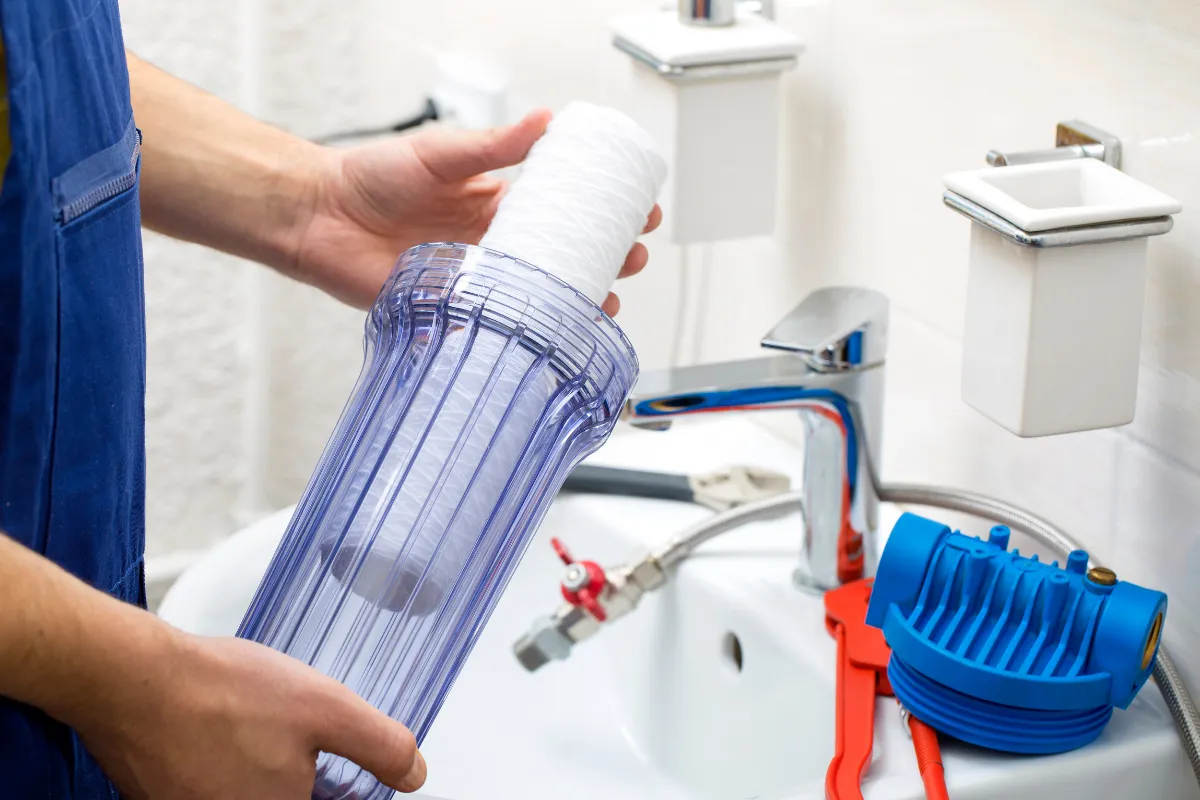
Compare whole-house water filtration system costs, loans and installer payment plans. Learn what to check before financing a system.
Page last reviewed: October 29, 2026 · By the Home Repair Financing editorial team
A whole-house water filtration system or water softener usually costs a few thousand dollars installed. You can pay for it with savings, a small personal loan, a dealer's payment plan or a credit card. Water filtration system financing makes the most sense once a water test shows what you actually need to remove.
This guide explains how to test your water first and how to tell a health need from a preference. It also covers what whole-house filters and softeners cost to buy and keep running, and how to compare financing so you don't overpay for equipment you don't need.
Key Takeaways
You can finance a water filtration system or softener with a personal loan, a dealer's payment plan or a credit card. Because these systems often cost less than major repairs, the total cost of a plan matters more than a low monthly payment.
| Option | Good fit when | Watch out for |
|---|---|---|
| Unsecured personal loan | You want a fixed payment and a set payoff date, and you've already chosen the system | Rates and approval depend on the lender and your credit. An origination fee may be taken out of the loan, so you receive less than you borrow. |
| Dealer or installer financing | The dealer offers a true 0% APR or low rate you can pay off on time | Some promos use deferred interest, which can charge interest back to the start if you miss the payoff deadline. Compare the cash price with the financed price. |
| 0% intro APR credit card | The system costs a few thousand dollars or less and you can pay it off before the intro period ends | Any balance left after the intro period is charged the card's regular rate. |
| Savings or a smaller system | Your test shows a single issue a point-of-use filter can handle | A filter at one faucet doesn't treat water for showers or appliances. |
If a dealer offers a free in-home water test, treat it as part of a sales visit and confirm the results with a certified lab. Then compare quotes and the total financed price before you sign. Our comparison of contractor financing vs. a personal loan covers what to check in a dealer's plan.
Learn what's in your water, and what you want removed, before you talk to dealers, the EPA advises. How you do that depends on where your water comes from.
| Your water source | Where to start |
|---|---|
| Public water system | Read your annual water quality report, called a Consumer Confidence Report. Water suppliers must send it each year, and you can call yours or use the EPA's search tool to find it. |
| Private well | You're responsible for testing. The CDC says to test at least once a year for coliform bacteria, nitrates, total dissolved solids and pH, using a state-certified lab. |
| Either source, older plumbing | Lead can enter water from your home's pipes and fixtures, so a tap test is the only way to know. Testing typically costs $20 to $100, the EPA says. |
Sources: EPA and CDC. EPA's public water rules don't apply to private wells, the CDC notes.
Well owners should test more often in some cases. The CDC recommends testing if your water's taste, color or smell changes, after flooding, after repairs to the well, or if someone in the home becomes pregnant or a child starts living with you. Your local or state health department can help you read the results and decide what else to test for.
For taste, odor or staining problems, the EPA suggests tests for things like iron, manganese, hardness and sulfate. A clear lab report lets you shop for a system rated for those specific problems instead of a bundle you don't need.
This question decides how urgent the purchase is and how much it's worth borrowing for. Your test results usually point the way.
| What the test or report shows | What it usually means |
|---|---|
| Bacteria, nitrates or lead above safe levels | A health issue. Follow your health department's or utility's advice now, and choose treatment certified for that contaminant. |
| A notice from your water company about a contaminant | Follow the notice. Water companies must tell you when contaminants are in the water they provide. |
| Hard water (scale, spots, soap scum) | A nuisance, not a health concern. A softener is a comfort and maintenance choice. |
| Chlorine taste, odor or staining with no health issue | Mostly a preference. A less costly filter may be enough. |
Sources: USGS (hard water), EPA and CDC. Your health department or a certified lab can interpret your specific results.
Hard water can still cost you money. Heated hard water leaves mineral scale that can clog pipes, shorten equipment life and lower water heater efficiency, the USGS explains. If scale is the main problem, compare the cost of a softener with the cost of the damage it prevents, and see our water heater financing guide if your heater is already failing.
If Your Water May Be Unsafe Now
Don't wait on financing to protect your family. If a test or notice shows lead, use only cold water for drinking and cooking and a filter certified to remove lead, the EPA advises. For a well with bacteria or nitrates, contact your local health department for next steps, and use another safe water source in the meantime.
The average water treatment system costs about $2,273, with most homeowners spending $1,130 to $3,538, according to Angi. Whole-house systems start around $1,500 and can reach $10,000.
| System type | Typical cost | What it treats |
|---|---|---|
| Under-sink filter | $150 to $600 | One faucet |
| Reverse osmosis | $300 to $2,500 | Pushes water through a very fine membrane |
| UV purification | $500 to $2,000 | Uses ultraviolet light to treat germs |
| Water softener | $700 to $3,000 | Hardness minerals for the whole house |
| Whole-house filtration system | $1,500 to $10,000 | All the water entering the home |
| Combination system | $2,000 to $6,000 | Two or more problems at once |
Source: Angi national cost estimates. Ask whether a quote includes installation.
For softeners specifically, Fixr puts the installed average at about $2,500, with most people paying $1,100 to $3,000. Single-tank salt-based units run $650 to $1,500, and dual-tank units $1,500 to $3,000.
Running costs matter when you borrow, because you'll pay them on top of the loan. Whole-house filtration often costs $150 to $500 a year to maintain, Angi says, with replacement filters at $20 to $200 each every three to 12 months. Softener salt or chemicals add about $10 to $40 a month, according to Fixr.
Your monthly payment depends on how much you borrow, your APR and how long you take to repay. Since most systems cost less than $5,000, the examples below use a 3-year term at three example APRs.
| Loan amount (3-year term) | At 12% APR | At 20% APR | At 28% APR |
|---|---|---|---|
| $1,500 | $50/mo, $294 interest | $56/mo, $507 interest | $62/mo, $734 interest |
| $3,000 | $100/mo, $587 interest | $111/mo, $1,014 interest | $124/mo, $1,467 interest |
| $5,000 | $166/mo, $979 interest | $186/mo, $1,689 interest | $207/mo, $2,445 interest |
These are example APRs to show how your rate changes the cost, not current offers. Personal loan APRs vary widely by lender and credit. Examples assume a fixed rate and no fees, rounded to the nearest dollar, and an origination fee would raise your actual cost.
Add the yearly filter or salt cost to these payments to see your real monthly cost. For larger combination systems, our guide to a $5,000 home improvement loan shows more payment options.
Use the calculator below to estimate your monthly payment and total interest. Enter the amount you plan to borrow, an estimated APR and a repayment term. Your actual loan offer may include different rates or fees.
Your Estimate
Monthly Payment
This calculator gives estimates only. It isn't a loan offer or a promise to lend. Your actual APR, loan amount and terms depend on the lender's review of your credit and income, and limits vary by state. The slider ranges are for estimating and don't reflect what lenders offer.
Powered by: Home Repair Financing
Help is more common for testing than for equipment. It's still worth checking before you borrow, especially if you have a health concern.
Our guide to home repair grants lists more places to look for help. If a test shows bacteria, nitrates or lead, use a safe water source now rather than waiting on a program.
Watch for "Guaranteed Approval"
Legitimate lenders won't promise or guarantee you a loan before you apply, the FTC warns, and no real lender will say that paying a fee guarantees you'll get one. If someone wants a fee up front before granting the loan, walk away. Learn more about how to spot home repair scams.
Related Resources
Yes. Common options include a personal loan, a dealer's payment plan and a 0% intro APR credit card. Approval and rates depend on the lender and your credit, so compare the total cost, not just the monthly payment.
It depends on what's in your water. If a test shows a problem that affects water you shower or wash with, a whole-house system may make sense. If you only want better drinking water, a filter at one tap may cost far less.
Only if hard water is causing problems you want to fix, such as scale or soap scum. Hard water isn't a health concern, but scale can shorten the life of water heaters and fixtures. A hardness test tells you how hard your water is.
No. A softener removes hardness minerals like calcium and magnesium, which aren't a health concern. It isn't designed to treat bacteria, nitrates or lead, so you'd need a system certified for those contaminants.
At least once a year for coliform bacteria, nitrates, total dissolved solids and pH. Test sooner after flooding, well repairs or a change in taste, color or smell.
Some will. Look for a filter certified to remove lead, and check that the certification covers lead specifically. Testing is the only way to know whether lead is in your water.
Plan for ongoing costs each year. Filters need replacing every few months to a year, and softeners need salt or chemicals. Ask the dealer for the yearly maintenance cost before you buy.
It can flag a problem, but it isn't a substitute for a certified lab test. Get independent results before you commit to an expensive system.
There's no single minimum. Each lender sets its own requirements, and many personal loan lenders look for a score of about 580 or higher, according to Bankrate. A higher score usually means a lower rate.
We use EPA, CDC and USGS guidance and national cost guides to explain water testing, treatment costs and financing. Cost estimates are national averages and vary by home and region. Our payment examples are estimates, not loan offers. Rates and program rules can change.
See what loan options may be available for a water filtration system or softener. It's free to submit a request, and you don't have to accept any offer. If you're matched, a participating lender may contact you directly and will set its own eligibility, rates, fees and funding time.
This page was written with the help of AI tools and reviewed and fact-checked by the Home Repair Financing editorial team.