
Compare whole-house generator installation costs, loans and contractor payment plans. See what affects the total price and financing cost.
Page last reviewed: October 29, 2026 · By the Home Repair Financing editorial team
A home standby generator often costs several thousand dollars for the unit, plus installation, a transfer switch and permits. Generator financing usually comes from a personal loan, a dealer or installer payment plan or a home equity loan, while a smaller portable generator may fit a credit card or savings.
This guide compares standby and portable generators, breaks down what each costs, explains permits and transfer switches and covers the carbon monoxide safety rules that matter most. It also shows what a generator loan could cost each month.
Key Takeaways
You can pay for a generator with a personal loan, financing through the dealer or installer, a home equity loan or line of credit, or a credit card for a portable unit. The best fit depends on the total installed price and how quickly you need it.
| Option | Good fit when | Watch out for |
|---|---|---|
| Unsecured personal loan | A standby generator and you want a fixed payment without using your home as collateral | Rates depend on your credit and the lender. An origination fee (an upfront charge) may come out of the loan, so you get less than you borrow. |
| Dealer or installer financing | The installer offers a true 0% APR or low rate you can repay on time | Deferred-interest promos can charge back interest if you miss the payoff date. Compare the financed price with the cash price. |
| Home equity loan or home equity line of credit (HELOC) | A large whole-home system or a generator added to other electrical work | Your home secures the debt. Closing takes longer, so it may not work if a storm is coming. |
| Credit card | A portable generator you can pay off within a few months | Regular card APRs are high, so a balance you carry for years costs a lot. |
A standby install takes time for quotes, permits and the work itself, so it's easier to plan before storm season than during an outage. Planning ahead also gives you time to compare financing. If your panel or wiring needs work to support a generator, our electrical repair financing guide covers panel upgrades.
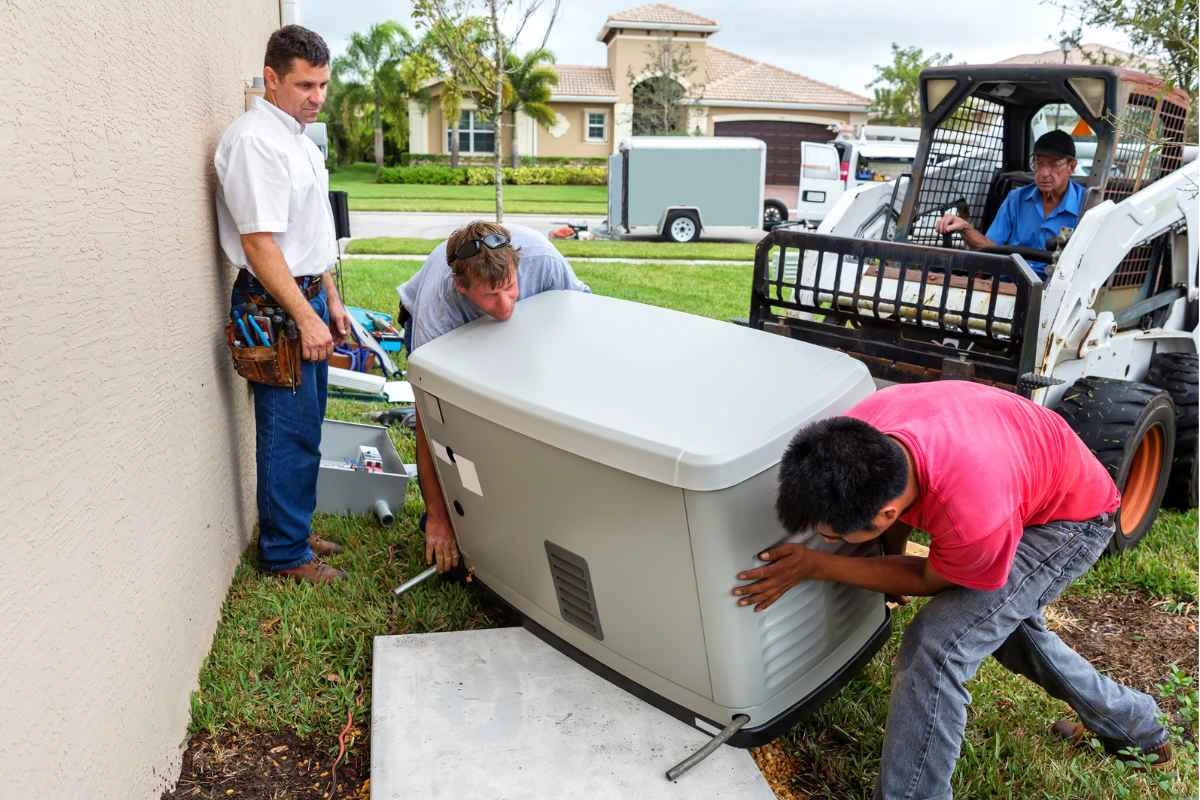
A standby generator is permanently installed outside your home and wired to your electrical system. It can start on its own when the power goes out. A portable generator sits on wheels, runs on fuel you add by hand and must be started and connected yourself.
| Feature | Standby generator | Portable generator |
|---|---|---|
| What it powers | The whole house or selected critical systems | A few appliances or circuits |
| How it starts | Automatically, with an automatic transfer switch | Manually, each time |
| Fuel | Usually natural gas line or propane tank | Usually gasoline or diesel, refilled by hand |
| Unit price | About $2,000 to $20,000 or more, depending on size | About $200 to $6,000 |
| Installation | Professional install, transfer switch and permits | None for cord use; a transfer switch or inlet box if you connect it to home wiring |
Source: HomeAdvisor. Prices are for equipment; standby installation is extra.
A standby unit makes the most sense if you lose power often, have long outages, work from home or rely on a sump pump, well pump or medical equipment. A portable generator may be enough if outages are rare and short and you only need the refrigerator, a few lights and phone charging.
Generator size, measured in kilowatts (kW), is the biggest price factor. A larger unit powers more of your home at once but costs more to buy, install and fuel. An electrician or installer can add up what you need to run and recommend a size.
| Size | Typical use | Unit price |
|---|---|---|
| 1 to 6 kW | Portable backup for a few essentials | $500 to $1,800 |
| 7.5 to 10 kW | Essential circuits, homes under 1,500 sq. ft. | $2,000 to $3,500 |
| 14 to 18 kW | Critical systems, 1,500 to 3,000 sq. ft. | $4,000 to $5,500 |
| 20 to 24 kW | Main systems, 3,000 to 5,000 sq. ft. | $5,000 to $6,500 |
| 26 to 32 kW | Main systems plus extra appliances | $6,500 to $15,000 |
Source: HomeAdvisor unit prices. Bob Vila lists the same ranges. Installation is not included.
Installation can add as much as the unit itself. Ask for an itemized quote so you know the full amount you'd finance.
| Installation cost | Typical cost |
|---|---|
| Permits | $50 to $200 each |
| Propane tank, if no natural gas | $300 to $1,500 |
| Manual transfer switch | $500 to $1,300 |
| Automatic transfer switch | $600 to $2,500 |
| Concrete pad | $50 to $75 per sq. ft. |
| Installation labor for a standby unit | $1,500 to $5,000 |
Source: HomeAdvisor. Gas line work, electrical panel upgrades and yearly maintenance are extra. HomeAdvisor puts maintenance at about $170 to $400 a year.
For a standby generator, almost always. HomeAdvisor says you'll likely need permits for the electrical work and for any gas line or fuel tank. Rules vary by city and county, and some areas or homeowners associations may also limit where a generator can go. A licensed installer usually handles the permits.
A transfer switch connects a generator to your home's wiring and switches it between utility and generator power. HomeAdvisor notes the National Electrical Code requires one for safety and to prevent backfeeding, which happens when generator power flows back into utility lines. Backfed power can endanger utility crews and your neighbors. A manual switch needs you to flip it, while an automatic switch changes over on its own.
Never Plug a Generator Into a Wall Outlet
Connecting a portable generator to your home through a wall outlet, sometimes with a homemade double-ended cord, bypasses the transfer switch and can backfeed the power lines. Use heavy-duty extension cords to plug appliances directly into a portable generator, or have a licensed electrician install a transfer switch or inlet box.
Standby generators need regular care to start when you need them. Bob Vila recommends service about every 200 hours of running time or every two years, whichever comes first, and says a well-maintained unit can last at least 20 years.
Generators make carbon monoxide (CO), a gas you can't see or smell. The CPSC says one portable generator can produce as much CO as hundreds of cars. Follow these rules from the CPSC and CDC:
Standby generators also make CO, which is one reason they're installed outdoors by professionals. Follow the manufacturer's placement instructions and local code for distance from windows, doors and vents.
Your monthly payment depends on how much you borrow, your APR and your repayment term. The examples below show estimated payments for common installed standby generator budgets at three example APRs.
| Loan amount (5-year term) | At 12% APR | At 20% APR | At 28% APR |
|---|---|---|---|
| $6,000 | $133/mo, $2,008 interest | $159/mo, $3,538 interest | $187/mo, $5,209 interest |
| $10,000 | $222/mo, $3,347 interest | $265/mo, $5,896 interest | $311/mo, $8,681 interest |
| $15,000 | $334/mo, $5,020 interest | $397/mo, $8,844 interest | $467/mo, $13,022 interest |
These are example APRs to show how your rate changes the cost, not current offers. Personal loan APRs vary widely by lender and credit. Examples assume a fixed rate and no fees, rounded to the nearest dollar, and an origination fee would raise your actual cost.
Your rate depends on your credit, income and existing debts. Our credit score requirements guide explains what lenders review, and our $10,000 home improvement loan guide shows payments for a typical standby budget.
Use the calculator below to estimate your monthly payment and total interest. Enter the amount you plan to borrow, an estimated APR and a repayment term. Your actual loan offer may include different rates or fees.
Your Estimate
Monthly Payment
This calculator gives estimates only. It isn't a loan offer or a promise to lend. Your actual APR, loan amount and terms depend on the lender's review of your credit and income, and limits vary by state. The slider ranges are for estimating and don't reflect what lenders offer.
Powered by: Home Repair Financing
Whole-home standby power is the most convenient option, but it isn't the only one. If the full price is more than you want to borrow, consider these steps.
Our guides to disability home repair financing and home repair help for seniors cover programs and loans that may help households that can't go without power.
Battery Backup and Solar
Home battery systems run silently and don't make carbon monoxide, but they often cost more than a standby generator. HomeAdvisor puts whole-home battery backup at about $10,000 to $25,000, while smaller batteries for critical systems cost less. If you're considering solar, a battery can be part of that project.
Watch for "Guaranteed Approval"
Legitimate lenders won't promise or guarantee you a loan before you apply, the FTC warns, and no real lender will say that paying a fee guarantees you'll get one. If someone wants a fee up front before granting the loan, walk away. Learn more about how to spot home repair scams.
Related Resources
A whole-house standby generator often costs many thousands of dollars once you add installation, a transfer switch, a pad and permits. The unit's size and whether you need a new gas line or propane tank make the biggest difference. Get itemized quotes from a few licensed installers.
Yes. Common options include a personal loan, dealer or installer financing, a home equity loan or line of credit, and a credit card for a portable unit. Approval and rates depend on the lender and your credit.
There's no single minimum. Each lender sets its own requirements, and many personal loan lenders look for a score of about 580 or higher, according to Bankrate. A higher score usually gets you a lower rate.
It depends on what you want to run at the same time. A unit for essential circuits can be much smaller than one for the whole house, especially if you have central air or electric heat. An electrician or installer can total your loads and recommend a size.
It can be if you want quiet backup power with no fuel and no carbon monoxide. Whole-home batteries often cost more up front, and they run for a limited time unless solar panels recharge them. They tend to suit shorter outages or homes that already have or plan to add solar.
Only through a properly installed transfer switch or inlet box. Plugging a generator into a wall outlet can send power back into utility lines, which can endanger utility workers and neighbors. Have a licensed electrician do the installation.
At least 20 feet, with the exhaust pointed away from your home, according to the CPSC. Never run it inside your home or garage, even with doors and windows open. Keep working CO alarms inside.
Natural gas is often cheaper to run and doesn't need refilling, but it requires a gas line to your home. Propane works where natural gas isn't available, though you'll need a tank and refills. Your installer can compare the two for your area.
A well-maintained standby generator can last 20 years or more. Regular service, exercise runs and prompt repairs help it start when you need it. Ask your installer about a maintenance plan when you buy.
We use cost guides and government safety sources to explain generator costs, installation and financing. Cost estimates are national averages and vary by home and region. Our payment examples are estimates, not loan offers. Rates and local rules can change.
See what loan options may be available for your home generator. It's free to submit a request, and you don't have to accept any offer. If you're matched, a participating lender may contact you directly and will set its own eligibility, rates, fees and funding time.
This page was written with the help of AI tools and reviewed and fact-checked by the Home Repair Financing editorial team.