
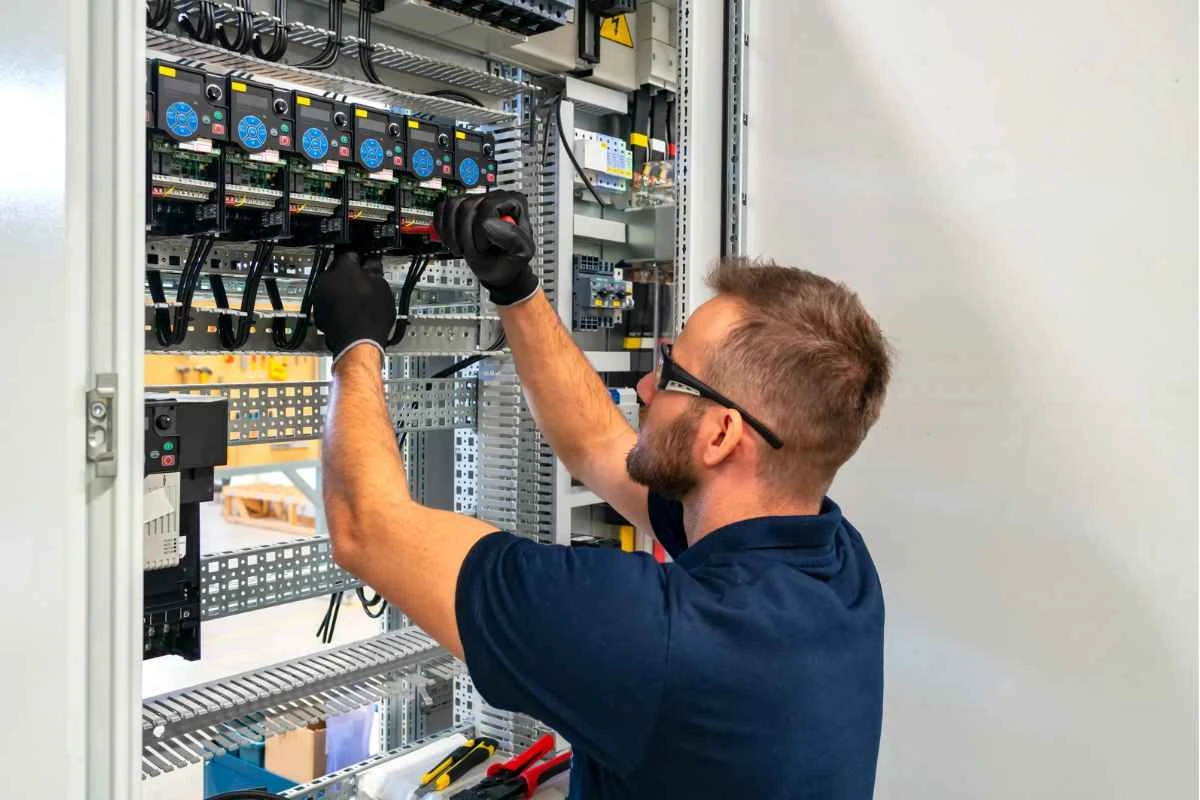
Replacing an outdated electrical panel? Compare upgrade costs, personal loans and payment plans for a safer home electrical system.
Page last reviewed: October 29, 2026 · By the Home Repair Financing editorial team
An electrical panel upgrade usually costs a few thousand dollars, and the bill can grow if your utility has to upgrade the service line or meter too. If you can't cover it in cash, electrical panel upgrade financing through a personal loan, your electrician's payment plan, home equity or a credit card can spread the cost into monthly payments.
This guide explains the signs that point to a new panel, what a 100-amp to 200-amp upgrade involves, how new loads like EV chargers and heat pumps change the math, and why some insurers care about older panels. It also covers permits, working with your utility and how to compare loan offers.
Key Takeaways
You can finance a panel upgrade with a personal loan, a payment plan from your electrician, a home equity loan or line of credit, or a credit card. Since many panel jobs cost a few thousand dollars, the cheapest option often depends on how fast you can pay it off.
| Option | Good fit when | Watch out for |
|---|---|---|
| Unsecured personal loan | You want a fixed payment and a set payoff date without using your home as collateral | Rates and approval depend on the lender and your credit. An origination fee may be taken out of the loan, so you receive less than you borrow. |
| Electrician or contractor financing | The electrician offers a true 0% APR or low rate you can pay off on time | Some promos use deferred interest, which can charge interest back to the start if you miss the payoff deadline. Compare the cash price with the financed price. |
| Home equity loan or home equity line of credit (HELOC) | The panel is part of a bigger project, like an addition or a whole-home electrification plan | Your home is collateral. HELOC rates are commonly variable, and closing costs can outweigh the savings on a small job. |
| 0% intro APR credit card | The bill is small enough to pay off before the intro period ends | Any balance left after the intro period is charged the card's regular rate, and the job may exceed your credit limit. |
| Utility or credit union energy loan | Your utility or a local credit union offers low-rate loans for panel or electrification work | Only some areas offer them, and they may require approved contractors or specific equipment. |
Some utilities point customers to low-rate financing for panel work. Vermont's Burlington Electric Department, for example, lists local credit union loans for panel upgrades, so it's worth asking yours. If an electrician offers a payment plan, read our comparison of contractor financing vs. a personal loan before you sign.
Your electrical panel, also called a breaker box, splits the power coming into your home into separate circuits. It's rated for a set amount of current, measured in amps. When the panel is too small, worn out or damaged, you may notice problems like these.
| What you notice | What it may mean |
|---|---|
| Burn marks, a hot panel or a buzzing sound | A possible fire hazard. Call a licensed electrician right away. |
| Breakers that trip often | Circuits may be overloaded, or a breaker may be failing |
| Lights that flicker or dim when appliances run | The service may be too small for your current loads |
| You have to unplug one thing to run another | Not enough capacity or circuits for how you use power |
| A fuse box or service under 100 amps | Common in older homes and often too small for modern loads |
| No open breaker spaces | No room to add circuits for new appliances |
Sources: Fixr, This Old House and NYSERDA Clean Heat Connect. Only an electrician can confirm the cause.
If a breaker keeps tripping, don't just keep resetting it. The CPSC says a tripped breaker is often a warning that the circuit is overloaded, and advises consulting a licensed electrician when in doubt. Signs of heat or burning are a safety issue, not something to put off while you shop for a loan.
Age matters too. Panels typically last 25 to 40 years, according to This Old House, and panels more than 30 years old may not support newer safety breakers. NYSERDA's guide says homes with under 100 amps or built before 1965 are likely to need more capacity.
They can. Some insurers may refuse to cover or renew homes with certain older panels, and replacing the panel can help you get or keep coverage, according to insurer Kin. Brands often flagged include Federal Pacific Electric (FPE) Stab-Lok, Zinsco and some Sylvania-branded versions, Pushmatic and Challenger.
Federal Pacific panels were common from about 1950 to 1980, and Zinsco and Sylvania panels mostly in the 1970s, Fixr says. Presenters at an ENERGY STAR partner meeting called Zinsco and Federal Pacific panels dangerous. The CPSC investigated FPE breakers but closed its case in 1983, saying the data available didn't establish a serious risk to consumers and that it couldn't spend more on testing. The agency didn't rule on whether the breakers are safe.
If an inspector or insurer flags your panel, ask your insurer exactly what it requires and by when. Get that in writing before you schedule work, so the replacement you finance actually solves the coverage problem. Replacing one of these panels usually costs about the same as other panel replacements, Fixr notes.
Panel upgrades cost $1,500 to $4,500 for most homeowners, with a national average of about $3,000, according to Fixr. The biggest cost driver is the amperage you're moving to. A 100-amp to 200-amp upgrade costs $1,300 to $3,000 for most people, This Old House says.
| Upgrading to | Typical cost, installed |
|---|---|
| 100 amps | $1,200 to $1,800 |
| 150 amps | $1,500 to $2,800 |
| 200 amps | $1,800 to $4,500 |
| 300 amps | $3,500 to $7,500 |
| 400 amps | $8,000 to $12,000 |
Source: Fixr national upgrade costs, labor included. A load calculation from your electrician decides the right size.
The panel itself is only part of the bill. Your quote may also include work outside the box.
| Possible add-on | Typical cost |
|---|---|
| Electrical permit | $50 to $300 |
| Meter box replacement, installed | $200 to $800 |
| Subpanel (a second, smaller panel) | $400 to $1,750 |
| Moving the panel | $800 to $3,000 |
| Larger service from the utility | $1,000 to $25,000 to the homeowner, in some cases |
Sources: This Old House (permit, subpanel, moving the panel), Fixr (meter box) and the ENERGY STAR partner presentation (service upgrade). Most jobs need only some of these.
Ask for an itemized quote that separates the panel, the service work and any utility charges. Our electrical repair financing guide covers rewiring and other repairs that sometimes come up during a panel job.
New electric equipment is a common reason people look at a 100-amp to 200-amp upgrade. A Level 2 EV charger runs on 240 volts, and some homes don't have the capacity for it, though an electrician can often add circuits, the U.S. Department of Energy says. A heat pump can draw up to 60 amps when it starts, depending on its size and style, according to NYSERDA.
Still, a new appliance doesn't automatically mean a new panel. In one California program, only 480 of 10,446 heat pump installs, about 4.6%, needed a panel replacement, the ENERGY STAR presenters reported. They named solar and EV charging as bigger drivers of upgrades.
Before you borrow, ask the electrician for a load calculation. This is a standard method in the electrical code that adds up your existing and planned loads, sometimes using a year of your actual usage data. It shows whether your current service can handle the new equipment.
| Alternative to a full upgrade | Typical cost | How it works |
|---|---|---|
| Circuit-sharing device | $300 to $600 plus installation | Lets two big loads share one circuit, such as a dryer and an EV charger, so they don't run at full power together |
| Circuit-pausing device | $400 to $900 plus installation | Cuts some loads when your total use nears the panel's limit |
| Smart panel | $3,000 to $5,000 plus installation | Monitors and manages loads circuit by circuit |
| Subpanel | $400 to $1,750 | Adds breaker spaces when you have capacity but no room |
Sources: ENERGY STAR partner presentation (EPA, Lawrence Berkeley National Laboratory and SPAN) and This Old House (subpanel). Whether an option is allowed depends on your local code and inspector.
A panel upgrade usually needs an electrical permit and an inspection. Many electricians pull the permit and include it in their bid, and a final inspection often costs little or is built into the price, Fixr says. Ask whether the permit is in your quote, and don't make the last payment until the work passes inspection.
Your utility gets involved because the power has to be cut while the panel is swapped. At Burlington Electric, for example, the electrician contacts the utility, which schedules the disconnect and reconnect. The utility may charge for that and for any upgrades to its own equipment, on top of the electrician's fee. Rules differ by utility, so ask yours early.
Utility work can also slow things down. The ENERGY STAR presenters noted that service upgrades can face delays of three to six months, and longer when transformers are in short supply. If you're financing, ask the electrician for a realistic timeline before you accept a loan, since some lenders fund quickly and your payments may start before the job is done.
The swap itself is usually quick. A standard panel install takes four to eight hours with two electricians, though it can take several days if rewiring is needed, Fixr says. Plan for your power to be off during that time.
Your monthly payment depends on how much you borrow, your APR and how long you take to repay. Since many panel upgrades cost less than $5,000, the examples below use a 3-year term at three example APRs.
| Loan amount (3-year term) | At 12% APR | At 20% APR | At 28% APR |
|---|---|---|---|
| $2,000 | $66/mo, $391 interest | $74/mo, $676 interest | $83/mo, $978 interest |
| $3,000 | $100/mo, $587 interest | $111/mo, $1,014 interest | $124/mo, $1,467 interest |
| $5,000 | $166/mo, $979 interest | $186/mo, $1,689 interest | $207/mo, $2,445 interest |
These are example APRs to show how your rate changes the cost, not current offers. Personal loan APRs vary widely by lender and credit. Examples assume a fixed rate and no fees, rounded to the nearest dollar, and an origination fee would raise your actual cost.
If your project also includes a large service upgrade, the total can be much higher. Our guides to a $5,000 home improvement loan and a $15,000 loan show payments for bigger budgets.
Use the calculator below to estimate your monthly payment and total interest. Enter the amount you plan to borrow, an estimated APR and a repayment term. Your actual loan offer may include different rates or fees.
Your Estimate
Monthly Payment
This calculator gives estimates only. It isn't a loan offer or a promise to lend. Your actual APR, loan amount and terms depend on the lender's review of your credit and income, and limits vary by state. The slider ranges are for estimating and don't reflect what lenders offer.
Powered by: Home Repair Financing
Possibly, depending on where you live and your income. Check these before you borrow, since even partial help lowers how much you need to finance. Program rules and funding change, so confirm details with the program directly.
Our guides to home repair grants and low-income home repair loans list more places to look. If your panel shows signs of heat or burning, get it fixed first rather than waiting on a program decision.
Watch for "Guaranteed Approval"
Legitimate lenders won't promise or guarantee you a loan before you apply, the FTC warns, and no real lender will say that paying a fee guarantees you'll get one. If someone wants a fee up front before granting the loan, walk away. Learn more about how to spot home repair scams.
Related Resources
Yes. Common options include a personal loan, an electrician's payment plan, a 0% intro APR credit card for smaller bills, and a home equity loan or line of credit for larger projects. Approval and rates depend on the lender and your credit.
There's no single minimum. Each lender sets its own requirements, and many personal loan lenders look for a score of about 580 or higher, according to Bankrate. A higher score usually means a lower rate.
It depends on what you run. A 100-amp service may handle your current loads but come up short once you add an EV charger, heat pump or electric range. A load calculation from a licensed electrician is the way to know for sure.
The swap itself often takes most of a day, and your power will be off during the work. Extra rewiring can stretch it to several days. If the utility has to upgrade its equipment, scheduling can add weeks or months.
It might. Some utilities charge for disconnecting and reconnecting power and for upgrading their own equipment, on top of what you pay the electrician. Ask your utility about fees before you set your loan amount.
Many electricians and inspectors recommend it, and some insurers may refuse to cover or renew a home that has one. Have a licensed electrician inspect it, and ask your insurer what it requires.
Many panels last 25 to 40 years. Age alone doesn't mean you need a new one, but an older panel may lack room for modern circuits or newer safety breakers. Signs like heat, buzzing or burn marks need attention right away.
Sometimes. A circuit-sharing device can let an EV charger share a circuit with another large appliance, and a smart panel can manage loads. Many drivers also charge on a regular outlet overnight. Your electrician can tell you what your code and panel allow.
Possibly, but expect higher rates and fewer choices. A co-signer may help, and utility programs or rebates can lower how much you need to borrow. If the panel is a safety hazard, don't wait to fix it while you work on your credit; look for assistance instead.
We use cost guides, government and utility sources and insurer guidance to explain panel upgrade costs and financing. Cost estimates are national averages and vary by home and region. Our payment examples are estimates, not loan offers. Rates and program rules can change.
See what loan options may be available for your electrical panel upgrade. It's free to submit a request, and you don't have to accept any offer. If you're matched, a participating lender may contact you directly and will set its own eligibility, rates, fees and funding time.
This page was written with the help of AI tools and reviewed and fact-checked by the Home Repair Financing editorial team.