
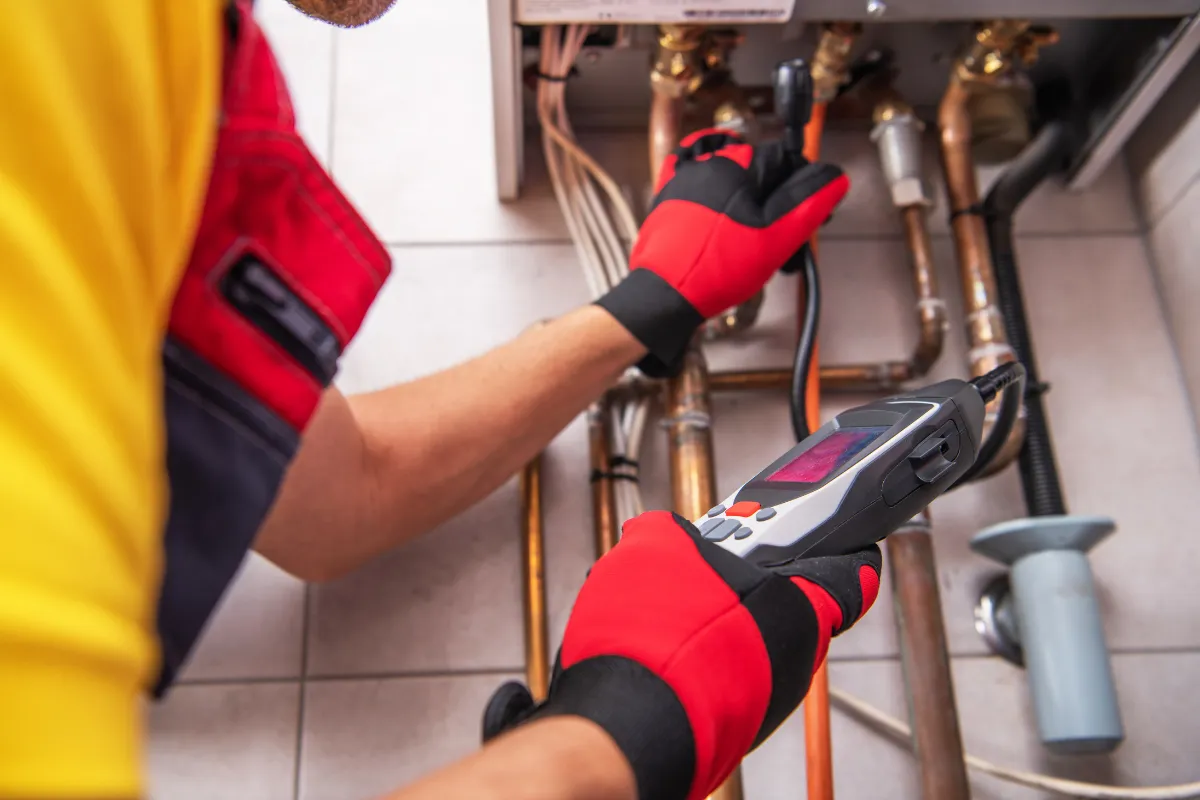
Explore gas line repair costs, who may be responsible and financing options. Suspect a gas leak? Leave the area and call for help first.
Page last reviewed: October 29, 2026 · By the Home Repair Financing editorial team
Many gas line repairs cost a few hundred dollars, but a leak in a buried line can run into the thousands. If you need gas line repair financing, a personal loan, a plumber's payment plan or a credit card can cover the bill. First, though, find out whether the leak is on your side of the meter or the utility's, since that decides who pays.
This guide starts with what to do if you smell gas. It then explains who's responsible for which pipes, what repairs cost, what insurance may cover, and how permits and inspections fit in before you borrow.
Key Takeaways
Smell Gas Right Now?
Stop reading and get everyone out of the house. Once you're outside and away from the building, call 911 or your gas company's emergency line. Financing can wait until the leak is under control.
Once you're safe and the gas is off, you can pay for a gas line repair with a personal loan, a payment plan from your plumber, a credit card or, for larger projects, home equity. Since many repairs are fairly small, a short payoff usually keeps interest low.
| Option | Good fit when | Watch out for |
|---|---|---|
| Unsecured personal loan | The repair involves a buried line or several thousand dollars, and you want a fixed payment | Rates and approval depend on the lender and your credit. An origination fee may be taken out of the loan, so you receive less than you borrow. |
| Plumber's payment plan | The plumber offers a true 0% APR or low rate you can pay off on time | Some promos use deferred interest, which can charge interest back to the start if you miss the payoff deadline. |
| 0% intro APR credit card | The repair is a few hundred dollars and you can pay it off before the intro period ends | Any balance left after the intro period is charged the card's regular rate. |
| Home equity loan or home equity line of credit (HELOC) | The gas work is part of a larger project, like replacing several lines or adding appliances | Your home is collateral, and closing costs can outweigh the savings on a small repair. |
For a few hundred dollars, a card you can pay off quickly may cost less than a loan with an origination fee. Our comparison of a personal loan vs. a credit card walks through that choice.
Gas companies add a chemical called mercaptan to natural gas so leaks smell like rotten eggs. If you notice that smell or hear gas escaping, treat it as an emergency. New Hampshire's pipeline safety office and Connecticut's utility regulator give the same core advice.
If you smell gas outdoors, report it and don't try to find the source yourself. Don't start a car or other engine near the smell.
After the emergency crew makes the area safe, they'll tell you whether the leak is on the utility's equipment or your own pipes. That answer decides your next step. If other urgent repairs pile up at the same time, see our guide to paying for emergency home repairs.
In most places, the gas company is responsible for the lines leading up to your home and for the gas meter, while the homeowner pays for pipes on the house side of the meter, Fixr explains. Local rules differ, so ask your gas company where its responsibility ends.
| Section of pipe | Usually maintained by | What to do |
|---|---|---|
| Gas main under the street and the service line to the meter | The gas company, in most places | Call the gas company. Ask whether it charges you for this work before anyone else starts. |
| The gas meter | The gas company, in most places | Don't touch it. The utility handles meter work. |
| Buried pipe from the meter to your house, a detached garage or an outdoor appliance | Usually the homeowner | Hire a licensed plumber or gas fitter. Digging raises the cost. |
| Pipes inside the house and to appliances | The homeowner | Hire a licensed pro. Many of these repairs are small. |
Sources: Fixr and federal pipeline safety rule 49 CFR 192.16. Where the meter sits and where utility responsibility ends vary by company.
Buried pipe on your side of the meter is easy to forget. Under the federal rule above, gas companies that don't maintain a customer's buried piping must tell the customer so in writing. The notice warns that unmaintained buried pipe can corrode and leak, and that it should be checked for leaks from time to time and repaired when it's unsafe.
That same rule says you should have buried gas pipe located before anyone digs near it, and digging should be done by hand. Plumbers, heating contractors and the gas company can help find, inspect and repair it.
Gas line repairs cost $150 to $700 for most homeowners, with an average of about $400, according to Fixr. Where the leak is matters most. A loose fitting behind a stove is a quick job, while a leak underground means digging.
| Repair or service | Typical cost |
|---|---|
| Gas line inspection | $50 to $75 |
| Pressure test (checks the system for leaks) | $75 to $100 |
| Leak at the junction behind a stove | $120 to $250 |
| Leak repair | $150 to $800 |
| Shut-off valve replacement | $350 to $600 |
| Pipe replacement | $23 to $35 per linear foot |
| Digging out a buried line leak (excavation and landscaping) | Adds $1,500 to $5,000 |
Sources: Fixr and HomeAdvisor (stove junction and buried line) national estimates. Prices vary by region and how hard the pipe is to reach.
Other costs can show up on the bill. Emergency same-day service can add $200 to $300, and finding a leak that's buried or hard to reach can add about $1,000 to $1,500 for excavation, Fixr says. If the pipe runs behind finished walls or in a crawl space, HomeAdvisor puts repairs for leaks hidden in walls or crawl spaces at $270 to $760.
Ask whether the plumber can repair just the leaking section or recommends replacing more pipe, and why. A small repair may be all you need, but corroded buried pipe may be worth replacing so you aren't paying for another leak soon.
Usually not for the pipe itself. Standard policies don't cover corrosion, age or normal wear, MoneyGeek explains, though gas lines inside your home may be covered when a covered event like a fire damages them. Service lines running from the street to your house often fall outside standard coverage too.
Some insurers sell a service line endorsement, an add-on that covers buried utility lines on your property. If you have one, or a separate gas line protection plan from your utility or a warranty company, call before repairs start and ask what's covered, what the limit is and whether you must use their contractor.
Keep the plumber's invoice and any permit or inspection record. If a problem leads to an insurance claim later, those papers show a licensed pro did the work.
Small repairs often don't need a permit, but moving, adding or replacing sections of gas pipe may, Fixr says. When one is needed, HomeAdvisor puts permit costs at $100 to $300. Your plumber should know the local rules and can usually pull the permit.
Repairs to gas lines on your property must follow local rules and be done by a licensed plumber where required, or by your gas company, Connecticut's PURA says. After the repair, the plumber may run a pressure test to confirm the system holds without leaking, and the local inspector may need to sign off.
If the gas company shut off your service for safety, don't turn it back on yourself. Ask the plumber what paperwork or inspection your utility needs before it restores service. Build that step into your timeline, especially in cold weather when you depend on gas heat.
Your monthly payment depends on how much you borrow, your APR and how long you take to repay. Since most gas line repairs cost less than $5,000, the examples below use a 3-year term at three example APRs.
| Loan amount (3-year term) | At 12% APR | At 20% APR | At 28% APR |
|---|---|---|---|
| $1,000 | $33/mo, $196 interest | $37/mo, $338 interest | $41/mo, $489 interest |
| $2,500 | $83/mo, $489 interest | $93/mo, $845 interest | $103/mo, $1,223 interest |
| $5,000 | $166/mo, $979 interest | $186/mo, $1,689 interest | $207/mo, $2,445 interest |
These are example APRs to show how your rate changes the cost, not current offers. Personal loan APRs vary widely by lender and credit. Examples assume a fixed rate and no fees, rounded to the nearest dollar, and an origination fee would raise your actual cost.
Some lenders have minimum loan amounts, so a very small repair may fit better on a card or a plumber's plan. For a buried line repair, our guide to a $5,000 home improvement loan shows more payment options.
Use the calculator below to estimate your monthly payment and total interest. Enter the amount you plan to borrow, an estimated APR and a repayment term. Your actual loan offer may include different rates or fees.
Your Estimate
Monthly Payment
This calculator gives estimates only. It isn't a loan offer or a promise to lend. Your actual APR, loan amount and terms depend on the lender's review of your credit and income, and limits vary by state. The slider ranges are for estimating and don't reflect what lenders offer.
Powered by: Home Repair Financing
A gas leak can't wait, so look for help at the same time you look at financing. Programs vary by area, and funding can run out, so call early.
Our guides to home repair grants and home repair loans for seniors list more programs. If the leak isn't fixed yet, keep the gas off while you wait for an answer.
Watch for "Guaranteed Approval"
Legitimate lenders won't promise or guarantee you a loan before you apply, the FTC warns, and no real lender will say that paying a fee guarantees you'll get one. If someone wants a fee up front before granting the loan, walk away. Learn more about how to spot home repair scams.
Related Resources
Yes. Common options include a personal loan, a plumber's payment plan and a 0% intro APR credit card for smaller bills. Approval and rates depend on the lender and your credit, so compare the total cost before you choose.
Usually not. Federal pipeline rules require a gas company that doesn't maintain your buried piping to tell you so in writing, since that pipe can corrode and leak if no one checks it. A plumber, heating contractor or the gas company can help locate and inspect it.
If the leak is on the gas company's lines or meter, the company generally handles the repair. Leaks on your side of the meter are usually your cost. Ask the company before work starts whether it will charge you for anything.
It depends on the plan's price, what it covers and its limits. Compare the yearly cost with what a buried line repair on your property might cost, and read the exclusions and any cap on each repair. Also check whether you have to use the plan's contractor.
The most common sign is a rotten egg smell, which comes from a chemical gas companies add because natural gas has no odor of its own. You might also hear hissing near a pipe or appliance. If you notice either, leave the building and call 911 or your gas company from outside.
Sometimes. Small repairs often don't need one, but moving, adding or replacing sections of pipe may. Your plumber should know the local rules and can usually pull the permit.
It's not a good idea. Gas leaks can cause fires and explosions, and many areas require a licensed plumber or gas fitter. Most cities also require a licensed pro before they'll issue a permit for gas work.
There's no single minimum. Each lender sets its own requirements, and many personal loan lenders look for a score of about 580 or higher, according to Bankrate. A higher score usually means a lower rate.
Don't use the gas until it's repaired. Call your gas company about payment arrangements, and ask local housing agencies or USDA, if you live in a rural area, about repair help. A plumber may be able to fix just the unsafe section first.
We use state safety agencies, federal pipeline rules, cost guides and insurance sources to explain gas line repair costs and financing. Cost estimates are national averages and vary by home and region. Our payment examples are estimates, not loan offers. Rates and program rules can change.
See what loan options may be available for your gas line repair. It's free to submit a request, and you don't have to accept any offer. If you're matched, a participating lender may contact you directly and will set its own eligibility, rates, fees and funding time.
This page was written with the help of AI tools and reviewed and fact-checked by the Home Repair Financing editorial team.