
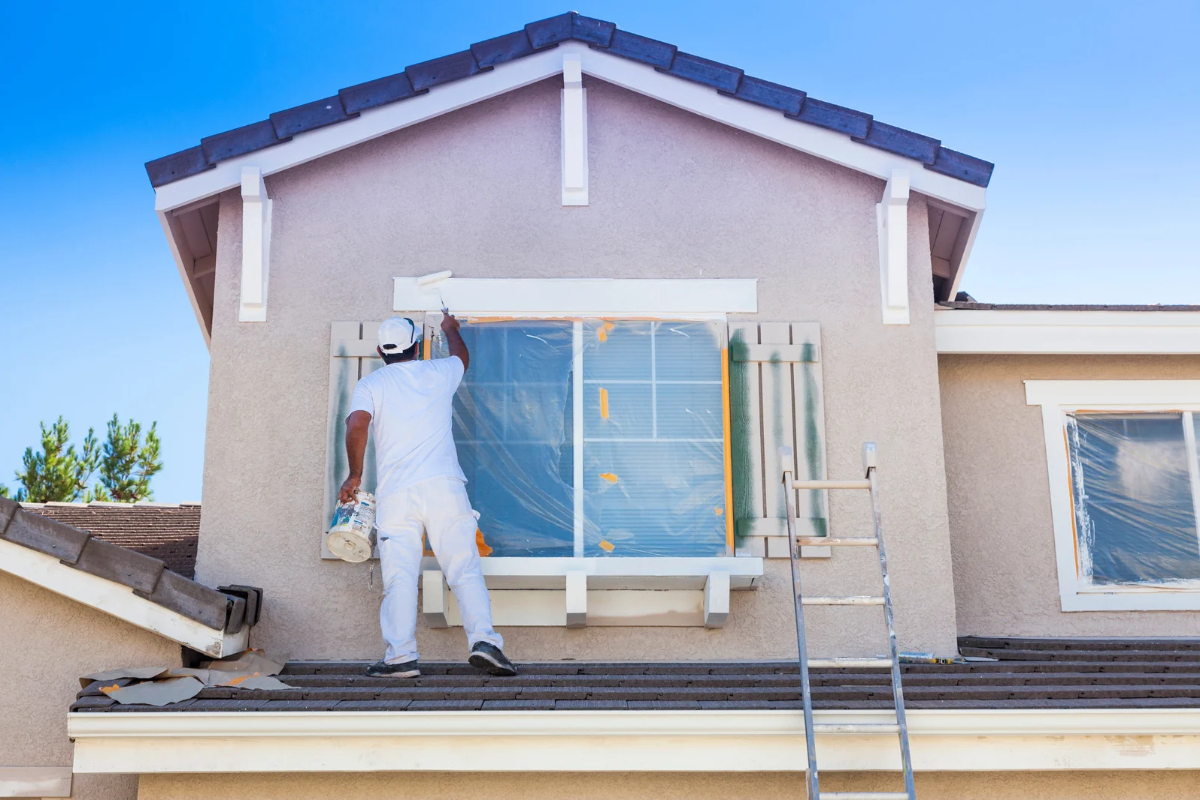
See what affects exterior house painting costs and compare personal loans, contractor financing and ways to manage the project budget.
Page last reviewed: October 29, 2026 · By the Home Repair Financing editorial team
Painting the outside of a house often costs a few thousand dollars, and more for a large, tall or older home that needs a lot of prep. If you can't pay upfront, exterior painting financing options include a personal loan, a painting company's payment plan or a 0% intro APR credit card you can pay off before the promo ends.
Exterior paint isn't only about looks. It's a barrier that helps keep water out of wood siding and trim. This guide explains when painting protects your home, the lead paint rules for homes built before 1978, what exterior painting costs, when to schedule it and how to pay for it.
Key Takeaways
You can finance exterior painting with a personal loan, a painting company's payment plan or a credit card. Because most paint jobs cost less than other exterior projects, a short repayment term usually keeps interest low.
| Option | Good fit when | Watch out for |
|---|---|---|
| Unsecured personal loan | You want a fixed payment and a set payoff date for a full repaint | Rates and approval depend on the lender and your credit. An origination fee may be taken out of the loan, so you receive less than you borrow. |
| Painting company payment plan | The painter offers a 0% or low-rate plan you can pay off on time | Some promos use deferred interest, which can charge interest back to the start if you miss the payoff deadline. Compare the cash price with the financed price. |
| 0% intro APR credit card | The job is small, like trim or one or two sides, and you can pay it off during the intro period | Any balance left after the intro period is charged the card's regular rate. |
| Home equity loan or home equity line of credit (HELOC) | Painting is one part of a larger exterior project, such as siding or window work | Your home is collateral, and closing costs can outweigh the benefit on a small loan. |
Painting is usually something you can plan, so you often have time to save for part of it and finance less. If a painter offers financing, our comparison of contractor financing vs. a personal loan explains what to compare.
On wood siding and trim, paint does more than add color. Paint provides the most protection of common wood finishes, according to a Purdue Extension and USDA Forest Products Laboratory guide. Once the paint film cracks or peels, water can reach the bare wood.
Paint usually fails first at the ends and edges of boards, the guide says, and it tends to peel where moisture is a problem. Watch for these signs that it's time to repaint:
Painting on time keeps the job simpler. Once paint fails badly, the painter has to scrape, sand and repair more before priming. HomeAdvisor says rot found during prep is fixed before painting, and remedial work can raise labor costs by 100% or more.
Peeling paint can also point to a moisture problem inside the wall, such as a leak or poor ventilation. New paint won't fix that. Ask the painter to point out any areas that keep peeling so the cause can be fixed first.
If your home was built before 1978, it may have lead-based paint. About three-quarters of U.S. homes built before 1978 still contain some lead paint, according to the EPA. Scraping or sanding it creates chips and dust that are hazardous if swallowed or inhaled, and the EPA says the key is keeping children from coming into contact with lead.
The EPA's Renovation, Repair and Painting (RRP) Rule sets requirements for anyone paid to disturb painted surfaces in pre-1978 homes. Here's what it requires, based on the EPA's compliance guide for contractors.
The rule generally doesn't apply to homeowners painting their own home, the EPA says, unless you rent out part of it, run a child care center there or flip homes. The EPA still recommends hiring a lead-safe certified contractor and lists lead-safe steps for do-it-yourselfers. Program details and penalties are updated from time to time, so ask any painter to show their current certification.
Lead-safe painting is different from lead abatement, which permanently removes or encloses lead paint. HomeAdvisor puts lead paint abatement at about $8 to $17 per square foot, so it costs far more than a lead-safe repaint.
HomeAdvisor puts the average exterior paint job at about $3,178, with most homeowners paying $1,819 to $4,551. The number of stories matters a lot, since taller walls need ladders or scaffolding and take longer.
| Home | Approximate paintable area | Typical cost |
|---|---|---|
| One story | 1,000 to 1,500 sq. ft. | $1,500 to $3,500 |
| Two stories | 1,500 to 2,500 sq. ft. | $3,000 to $6,200 |
| Three stories | 2,500 to 3,000 sq. ft. | $4,500 to $10,000 or more |
Source: HomeAdvisor national estimates. Siding type, condition and local labor rates change the price.
Prep and extras can add to the quote. Ask for an itemized estimate so you can see what's included.
| Prep or add-on | Typical cost |
|---|---|
| Power washing | $240 to $400 |
| Scraping or paint stripping | $0.50 to $2 per sq. ft. |
| Caulking and masking | $0.50 to $1 per sq. ft. |
| Repairs, including rot or damaged siding | $25 to $50 per hour |
| Trim | $1 to $6 per linear ft. |
| Porch | $500 to $2,000 |
Source: HomeAdvisor. Most jobs need only some of these.
Regional differences. HomeAdvisor's averages for a 1,500 sq. ft. home range from about $2,300 in the Plains and $2,400 in the Southwest to about $4,500 in the Far West and $4,800 in New England. Getting two or three local quotes is the best way to know your price.
Mild, dry weather is best. Spring and fall are often good choices because they avoid summer heat and winter cold, NerdWallet notes. Temperature and moisture matter more than the calendar, though.
Traditional latex paints need temperatures above about 50 to 60 degrees Fahrenheit to cure well, while some newer products can go on at temperatures as low as 35 degrees, according to Sherwin-Williams. The paint maker says the temperature should ideally stay in the label's range and above the dew point for 48 hours after painting. It also recommends waiting at least a day after heavy rain, and longer for wood and masonry, which hold more moisture.
How often you'll repaint depends on the surface. HomeAdvisor says exterior paint is generally made to last five to 10 years, with wood siding often needing a new coat every three to seven years. Booking in a slower season can sometimes lower the price, HomeAdvisor adds, as long as the weather allows.
Your monthly payment depends on how much you borrow, your APR and how long you take to repay. The examples below show estimated payments for common exterior painting costs at three example APRs.
| Loan amount (3-year term) | At 12% APR | At 20% APR | At 28% APR |
|---|---|---|---|
| $2,000 | $66/mo, $391 interest | $74/mo, $676 interest | $83/mo, $978 interest |
| $3,500 | $116/mo, $685 interest | $130/mo, $1,183 interest | $145/mo, $1,712 interest |
| $5,000 | $166/mo, $979 interest | $186/mo, $1,689 interest | $207/mo, $2,445 interest |
These are example APRs to show how your rate changes the cost, not current offers. Personal loan APRs vary widely by lender and credit. Examples assume a fixed rate and no fees, rounded to the nearest dollar, and an origination fee would raise your actual cost.
See what borrowers with scores around 580 or 600 can expect, or how a $3,000 home improvement loan works for a typical paint job. A shorter term raises the monthly payment but cuts the total interest you pay.
Use the calculator below to estimate your monthly payment and total interest. Enter the amount you plan to borrow, an estimated APR and a repayment term. Your actual loan offer may include different rates or fees.
Your Estimate
Monthly Payment
This calculator gives estimates only. It isn't a loan offer or a promise to lend. Your actual APR, loan amount and terms depend on the lender's review of your credit and income, and limits vary by state. The slider ranges are for estimating and don't reflect what lenders offer.
Powered by: Home Repair Financing
If a full repaint isn't in your budget, focus on the areas where bare wood is exposed. Protecting those spots now can prevent rot repairs that cost more later.
Homeowners 62 and older can also see our guide to senior home repair loans for more programs. If you can't qualify for a loan, painting the worst areas first and asking about local programs can still protect the wood.
Watch for "Guaranteed Approval"
Legitimate lenders won't promise or guarantee you a loan before you apply, the FTC warns, and no real lender will say that paying a fee guarantees you'll get one. If someone wants a fee up front before granting the loan, walk away. Learn more about how to spot home repair scams.
Related Resources
It may be possible, but expect higher rates and fewer choices. Some lenders work with lower scores, and a cosigner or a smaller loan can help. Because most paint jobs aren't urgent, saving for part of the cost can also shrink what you borrow.
You can. Common options include a personal loan, a payment plan from the painting company and a 0% intro APR credit card for smaller jobs. Approval and rates depend on the lender and your credit.
There's no single minimum. Each lender sets its own requirements, and many personal loan lenders look for a score of about 580 or higher, according to Bankrate. A higher score usually means a lower rate.
For paid work that disturbs paint in a home built before 1978, yes. Under the EPA's RRP Rule, the firm must be lead-safe certified and follow lead-safe work practices. Ask to see the firm's certification before you sign.
The EPA's RRP Rule generally doesn't apply to homeowners working on their own home, unless you rent it out, run a child care center there or flip homes. The EPA still recommends lead-safe practices, like containing dust, wearing protection and cleaning carefully. It also recommends hiring a lead-safe certified contractor.
If your home was built before 1978, assume it may have lead paint until a test shows otherwise. A certified lead inspector or risk assessor can test it, and the EPA's lead pages explain your testing options. A lead-safe certified painter can also tell you what testing they use.
Many homes need repainting about every five to 10 years. Wood siding often needs it sooner, and sun, rain and the quality of the last paint job all play a part. Peeling paint and bare wood are signs it's time.
Yes. Paint won't stick well to rotted or damaged wood, and covering rot only hides it. Most painters fix small areas of rot during prep, which can raise the labor cost, so ask for repairs to be priced separately in the quote.
Not for normal fading, peeling or age, since that's routine maintenance. If a covered event, like a fire or hail, damaged the paint, repainting may be part of the claim. Check your policy and talk to your insurer.
Possibly. Some local programs help older, disabled or lower-income homeowners with exterior repairs, and some cities run lead hazard control programs for pre-1978 homes. Ask your local housing or health department what's available.
We use cost guides, manufacturer guidance, university research and government sources to explain exterior painting costs, lead rules and financing. Cost estimates are national averages and vary by home and region. Our payment examples are estimates, not loan offers. Rates and program rules can change.
See what loan options may be available for painting your home's exterior. It's free to submit a request, and you don't have to accept any offer. If you're matched, a participating lender may contact you directly and will set its own eligibility, rates, fees and funding time.
This page was written with the help of AI tools and reviewed and fact-checked by the Home Repair Financing editorial team.