
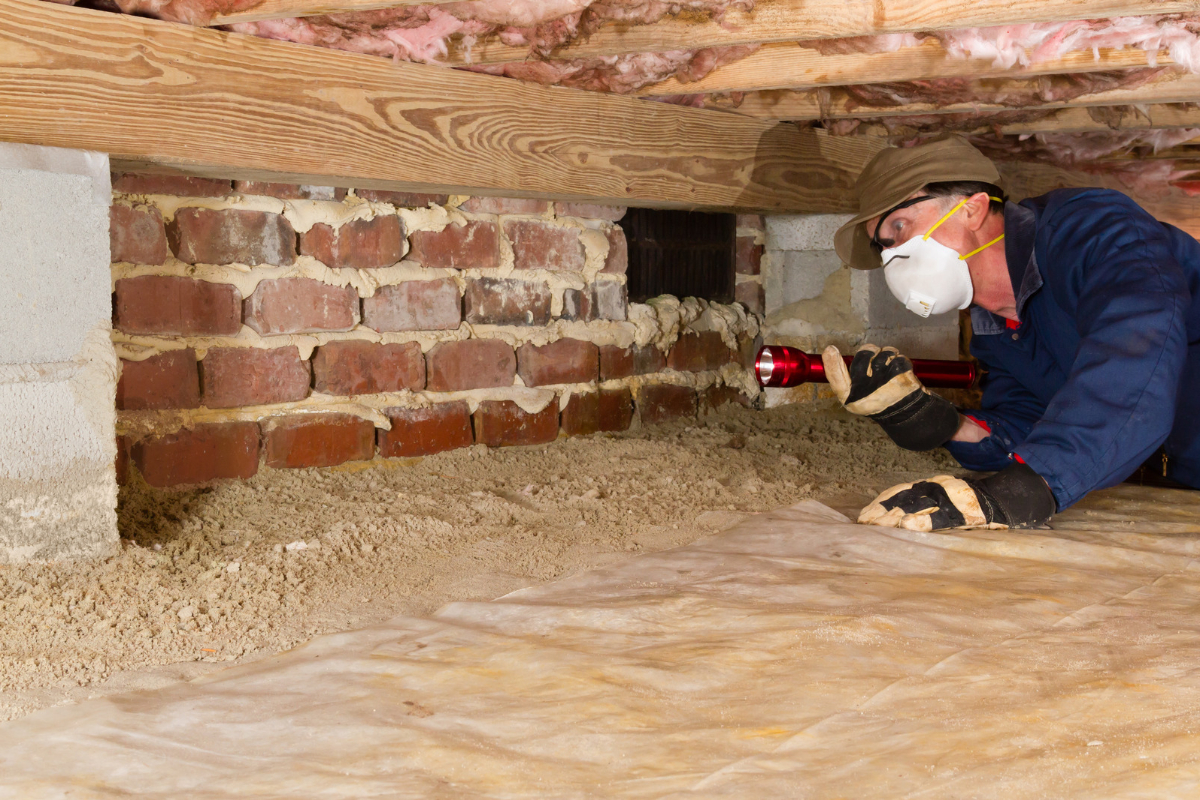
Compare crawl space encapsulation costs, moisture-control options and financing plans before choosing a contractor.
Page last reviewed: October 29, 2026 · By the Home Repair Financing editorial team
A damp crawl space can lead to musty smells, sagging floors and mold, and sealing it up isn't cheap. You can pay with savings or use crawl space encapsulation financing, such as a personal loan, financing from the installer, a credit card or home equity. Since a full job often costs several thousand dollars, it's worth knowing whether you need full encapsulation or a simpler fix first.
This guide explains how to tell whether your crawl space has a moisture problem, how encapsulation differs from a vapor barrier, what each costs and what to check before you seal the space. It also covers programs that may help with the bill.
Key Takeaways
You can finance crawl space encapsulation with a personal loan, a payment plan from the installer, a home equity loan or line of credit, or a credit card. The right choice depends on the size of the quote, your credit and whether other repairs, like drainage or framing, are part of the job.
| Option | Good fit when | Watch out for |
|---|---|---|
| Unsecured personal loan | You want a fixed payment and the job includes work from more than one contractor | Rates and approval depend on the lender and your credit. An origination fee may be taken out of the loan, so you receive less than you borrow. |
| Installer financing | The installer offers a true 0% APR or low rate you can pay off on time | Some promos use deferred interest, which can charge interest back to the start if you miss the payoff deadline. Compare the cash price with the financed price. |
| Home equity loan or home equity line of credit (HELOC) | Encapsulation is part of a bigger project and you have equity | Your home is collateral. HELOC rates are commonly variable, and closing can take longer than a personal loan. |
| 0% intro APR credit card | You're only adding a vapor barrier or a dehumidifier and can pay it off before the intro period ends | Any balance left after the intro period is charged the card's regular rate. |
Crawl space companies often sell encapsulation as a package with a dehumidifier, drainage and sometimes a service plan. Financing through the installer can be convenient, but it can make it harder to see what each piece costs. Ask for an itemized quote before you choose. Our guide to contractor financing vs. a personal loan covers what to compare.
Crawl spaces get damp in two main ways. Water can come in from outside, through poor drainage, leaks or a high water table. Or humid outdoor air can come in through the vents and condense on cooler wood and pipes. Existing vented crawl spaces have had serious moisture and mold problems, according to the U.S. Department of Energy.
Common warning signs, according to Bob Vila, include:
When you or a contractor look inside, wet or sagging insulation, damp wood and puddles after rain are also red flags. The cause of the moisture decides the fix.
Standing water after storms is a drainage problem, and encapsulation alone won't solve it. Humid air and condensation are what encapsulation is built for. If water is coming in, deal with gutters, grading or drainage first. Our basement waterproofing guide covers drains and sump pumps in detail.
A vapor barrier is a plastic sheet laid over the dirt floor to keep ground moisture from rising into the crawl space. Encapsulation goes further. It seals the whole space from the outside, usually with a heavier liner on the floor and walls, sealed vents, wall insulation and a way to control humidity.
| Feature | Vapor barrier only | Full encapsulation |
|---|---|---|
| What's included | Plastic sheeting over the ground | Liner on floor and walls, sealed vents and openings, often wall insulation and a dehumidifier |
| Vents | Usually stay open | Sealed |
| Humidity control | Blocks moisture from the soil only | Controls the air too, with a dehumidifier or conditioned air |
| Typical installed cost | About $1,200 to $4,000 | About $3,000 to $15,000 |
Source: HomeGuide national cost estimates. The size of your crawl space and any repairs needed first make the biggest difference.
A vapor barrier alone may be enough if the crawl space is dry most of the year and the main issue is damp soil. Full encapsulation makes more sense when humid air is causing condensation, mold or wet insulation. Sealed, insulated crawl spaces can save energy and improve comfort and durability in most climates, DOE research found, but they have to be built right.
A simple rule of thumb: if the contractor finds mold, wet framing or a musty smell in the house, ask about full encapsulation. If the space is dry and the problem is just bare dirt, ask whether a properly installed barrier would do the job for now.
HomeGuide puts crawl space encapsulation at about $3 to $10 per square foot, and Angi puts the national average at about $5,500. Size is the biggest cost driver, followed by how much prep and repair work the space needs.
| Crawl space size | Typical installed cost |
|---|---|
| 1,000 sq. ft. | $3,000 to $10,000 |
| 1,500 sq. ft. | $4,500 to $15,000 |
| 2,000 sq. ft. | $6,000 to $20,000 |
Source: HomeGuide. The size of a crawl space is usually close to the footprint of the floor above it.
Your quote may also include these items. Ask for each one to be listed separately so you can see what's essential.
| Possible add-on | Typical cost |
|---|---|
| Crawl space inspection | $100 to $250 |
| Sealing vents and holes | $150 to $450 |
| Interior drain system with pump | $800 to $3,000 |
| Wall insulation (rigid foam or spray foam) | $500 to $2,100 |
| Dehumidifier, installed | $1,000 to $3,000 |
| Mold remediation | $1,500 to $4,000 on average |
Source: HomeGuide. Most jobs need only some of these. Repairs to rotted joists or the foundation are priced separately.
A dehumidifier runs on electricity and needs regular upkeep, so ask about operating costs and filter or service needs. Some companies also sell yearly service plans. Those can be useful, but they're optional, so don't let one be bundled into your loan without a clear price.
Sealing a crawl space changes how air and moisture move through your home. DOE guidance for contractors converting vented crawl spaces calls for several checks, according to the Building America Solution Center. Ask your contractor how they'll handle each one.
Check your insurance, too. Standard homeowners insurance likely won't cover encapsulation, Bob Vila notes. If a sudden event, like a burst pipe, soaked the crawl space, the cleanup may be a separate insurance question from the encapsulation itself.
Your monthly payment depends on how much you borrow, your APR and how long you take to repay. The examples below show estimated payments for common encapsulation budgets at three example APRs.
| Loan amount (5-year term) | At 12% APR | At 20% APR | At 28% APR |
|---|---|---|---|
| $4,000 | $89/mo, $1,339 interest | $106/mo, $2,359 interest | $125/mo, $3,473 interest |
| $7,000 | $156/mo, $2,343 interest | $185/mo, $4,127 interest | $218/mo, $6,077 interest |
| $12,000 | $267/mo, $4,016 interest | $318/mo, $7,076 interest | $374/mo, $10,418 interest |
These are example APRs to show how your rate changes the cost, not current offers. Personal loan APRs vary widely by lender and credit. Examples assume a fixed rate and no fees, rounded to the nearest dollar, and an origination fee would raise your actual cost.
For a closer look at a mid-sized budget, see our $5,000 home improvement loan guide. Our credit score guides explain what borrowers with scores around 600 or 700 can expect.
Use the calculator below to estimate your monthly payment and total interest. Enter the amount you plan to borrow, an estimated APR and a repayment term. Your actual loan offer may include different rates or fees.
Your Estimate
Monthly Payment
This calculator gives estimates only. It isn't a loan offer or a promise to lend. Your actual APR, loan amount and terms depend on the lender's review of your credit and income, and limits vary by state. The slider ranges are for estimating and don't reflect what lenders offer.
Powered by: Home Repair Financing
If you can't afford full encapsulation, you may be able to get help with parts of the job or split it into stages. Programs vary by state and area, and many have income limits.
Our guides to home repair grants and low-income home repair loans list more programs. If you can't qualify for a loan, starting with gutters, grading and a vapor barrier may still cut the moisture while you save.
Watch for "Guaranteed Approval"
Legitimate lenders won't promise or guarantee you a loan before you apply, the FTC warns, and no real lender will say that paying a fee guarantees you'll get one. If someone wants a fee up front before granting the loan, walk away. Learn more about how to spot home repair scams.
Related Resources
It may be possible, but expect higher rates and fewer choices. Some lenders work with lower scores, and a cosigner or a smaller loan can help. Doing the job in stages, starting with drainage and a vapor barrier, can also lower what you borrow.
Yes. Common options include a personal loan, financing through the installer, a home equity loan or line of credit, and a credit card for smaller jobs. Approval and rates depend on the lender and your credit.
It's often worth it if humid air is causing mold, wet insulation or musty smells in your home. It's less useful if the crawl space is already dry, or if the real problem is water coming in, which needs drainage work first.
Yes. DOE's Building America checklist for sealing a vented crawl space calls for giving the homeowner a radon test kit after the work. If levels come back above EPA's action level, a radon mitigation system is the usual fix.
Usually, you need some way to control humidity once the vents are sealed. That can be a dehumidifier or a small amount of air from your heating and cooling system. Ask your contractor which approach fits your home and climate.
It depends on the design. Traditional crawl spaces rely on open vents, while encapsulated crawl spaces seal them. Closing vents without also adding a ground cover, insulation and humidity control can trap moisture, so don't just shut them on your own.
No. Encapsulation helps keep mold from coming back, but existing mold should be cleaned up first. Sealing over mold or wet wood can hide the problem and let it spread.
Some homeowners install a basic vapor barrier themselves. Full encapsulation is harder, since it involves sealing vents, insulating walls and controlling humidity. Gas appliances in the crawl space also need a safety test after sealing.
There's no single minimum. Each lender sets its own requirements, and many personal loan lenders look for a score of about 580 or higher, according to Bankrate. A higher score usually means a lower rate.
We use cost guides, Department of Energy research and government sources to explain crawl space encapsulation costs and financing. Cost estimates are national averages and vary by home and region. Our payment examples are estimates, not loan offers. Rates and program rules can change.
See what loan options may be available to seal and dry out your crawl space. It's free to submit a request, and you don't have to accept any offer. If you're matched, a participating lender may contact you directly and will set its own eligibility, rates, fees and funding time.
This page was written with the help of AI tools and reviewed and fact-checked by the Home Repair Financing editorial team.