
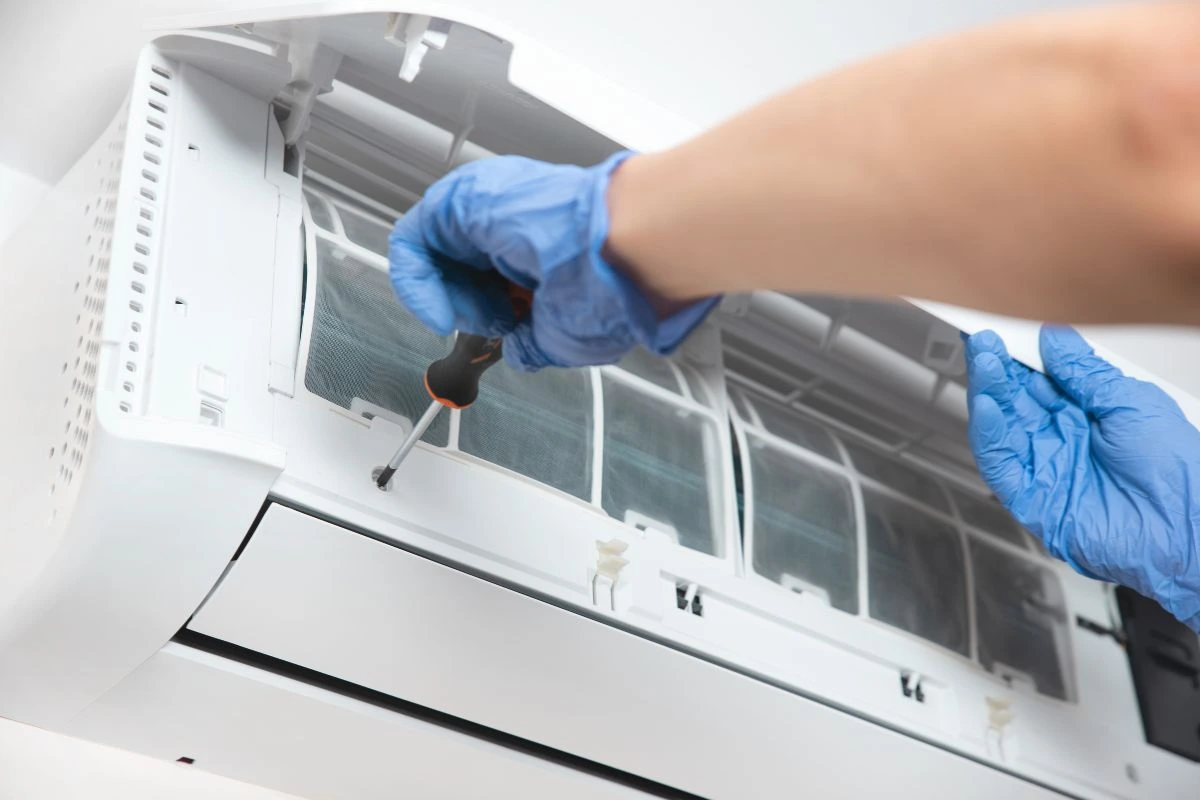
Need a new AC system? Compare replacement costs, personal loans and contractor financing, including what to check before accepting a payment plan.
Page last reviewed: October 28, 2026 · By the Home Repair Financing editorial team
A new central air conditioner often costs several thousand dollars, and the bill can climb if your home needs new wiring, ductwork or a matching indoor coil. If you can't pay for AC replacement out of pocket, you may be able to finance it with a personal loan, installer financing or another payment option.
Before you borrow, it helps to know whether your system really needs replacing, what a fair price looks like and how interest will change your total cost. This guide walks through those decisions, plus programs that may help if you can't afford a new unit.
Key Takeaways
You can finance an AC replacement through a personal loan, your HVAC installer, a home equity loan or line of credit, or a credit card. The right choice depends on your credit, how soon you need cooling and what the financing costs over time.
| Option | Good fit when | Watch out for |
|---|---|---|
| Unsecured personal loan | You want a fixed payment and don't want to borrow against your home | Rates and approval depend on the lender and your credit. An origination fee may be taken out of the loan, so you receive less than you borrow. |
| Installer or manufacturer financing | The installer offers a true 0% APR or low rate you can pay off on time | Some promos use deferred interest, which can charge interest back to the start if you miss the payoff deadline. Compare the cash price with the financed price. |
| Home equity loan or home equity line of credit (HELOC) | You have equity and are replacing more than just the AC | Your home is collateral. HELOC rates are commonly variable, and closing can take longer than a personal loan. |
| 0% intro APR credit card | The bill is small enough to pay off before the intro period ends | Any balance left after the intro period is charged the card's regular rate. |
During a heat wave, installers get busy, and waiting can be uncomfortable or even unsafe. If your system still runs, replacing it before it fails gives you time to compare quotes and financing instead of rushing. If your home is dangerously hot now, see our heat safety tips first. For a closer look at installer offers, see contractor financing vs. a personal loan.
A warm house doesn't always mean you need a new system. A failed capacitor or a bad thermostat can stop an AC from cooling, and both are fairly cheap to fix. Ask the technician what failed, what the repair costs and how much life the unit has left.
HomeAdvisor puts the average AC repair at about $408, with most people paying $170 to $646. Here's what common repairs cost.
| Repair | Typical cost | What it usually means |
|---|---|---|
| Thermostat | $60 to $440 | Usually a simple fix |
| Capacitor (a part that helps the motors start) | $120 to $475 | A common, fairly cheap repair |
| Refrigerant recharge | $100 to $600 | Low refrigerant usually means a leak, so ask about the cause |
| Refrigerant leak repair | $225 to $1,600 | Worth it on a newer unit; less so on an old one |
| Evaporator coil (the indoor cooling coil) | $600 to $2,000 | A major repair on an older system |
| Compressor | $1,200 to $2,800 | Often the point where a new unit makes more sense |
Source: HomeAdvisor national cost estimates. Prices vary by region, brand and season.
HomeAdvisor suggests two quick tests. First, multiply the repair cost by the unit's age in years, and consider replacing it if the result is more than $5,000. A $500 repair on a 12-year-old AC, for example, comes to $6,000.
Second, if a repair costs more than half the price of a new unit, replacement is usually worth a look. HomeAdvisor says an AC generally lasts 12 to 15 years, so these tests matter most on older systems.
Before you pay out of pocket, check your coverage. Homeowners insurance usually won't pay to replace an AC that wore out with age, but it may cover damage from events like lightning, fire or a fallen tree, Policygenius explains. If you have a home warranty or the unit is still under the manufacturer's warranty, check what it covers.
The biggest factor in AC replacement cost is the size of the system, measured in tons. Bigger homes need more cooling capacity, which costs more. Efficiency, brand and installation work also affect the price.
| System size | Approximate home size | Typical installed cost |
|---|---|---|
| 2 tons | About 1,000 to 1,300 sq. ft. | $2,500 to $5,500 |
| 3 tons | About 1,600 to 1,900 sq. ft. | $3,000 to $6,500 |
| 4 tons | About 2,200 to 2,600 sq. ft. | $3,500 to $7,500 |
| 5 tons | About 2,600 to 3,200 sq. ft. | $4,000 to $8,000 |
Source: PICKHVAC installed replacement costs. Home sizes are rough guides. A proper sizing calculation from your installer is more reliable.
Your quote may also include work beyond the unit itself. Ask for an itemized estimate so you know what you're paying for and how much you may need to finance.
| Possible add-on | Typical cost |
|---|---|
| Old unit removal and disposal | $50 to $200 |
| Smart thermostat, installed | $140 to $350 |
| Permit | $250 to $1,500 |
| Electrical work (new circuit or panel) | $850 to $4,000 |
| New ductwork | $2,400 to $6,600 |
Source: PICKHVAC. Most replacements need only some of these, if any.
R-22, often called Freon, was widely used in home air conditioners through the 2000s, so many older systems still use it. The U.S. stopped producing and importing new R-22 in 2020, according to the EPA. Older systems can still be serviced with recovered or reclaimed R-22, but supply is shrinking and it's getting harder and more expensive to buy, Carrier notes.
If an R-22 system has a leak or a major part failure, replacing it often makes more financial sense than paying for refrigerant again. Converting an old R-22 unit to a newer refrigerant usually requires major changes, so it's rarely worth it. Your technician can tell you which refrigerant your unit uses, or you can check the nameplate or sticker on the outdoor unit for "R-22" or "HCFC-22."
New systems are moving to a newer group of refrigerants, called A2Ls, that have less climate impact, according to the National Association of Home Builders. Rules on installing equipment that uses the older R-410A refrigerant have changed recently and can vary by state, with New York among those that restrict it, ACCA reported. Ask your installer which refrigerant a quoted system uses and whether parts and service will be easy to get.
An air conditioner's efficiency is measured by its SEER2 rating. A higher number means it uses less electricity to cool the same space. Federal minimums since 2023 are 13.4 SEER2 in the North and 14.3 SEER2 in the South and Southwest, according to Carrier.
Higher efficiency costs more up front. In PICKHVAC's estimates, a standard-efficiency system (13 to 14 SEER on the older rating scale) runs about $2,500 to $6,000 installed, while a 19 to 21 SEER system runs about $4,000 to $10,000. PICKHVAC uses the older SEER scale, so check the SEER2 rating on your quote. Financing the price difference adds interest, so a higher-efficiency unit takes longer to pay for itself if you borrow for it.
Higher efficiency tends to make the most sense where summers are long and hot and you run the AC for many months. If you live in a mild climate and use the AC only a few weeks a year, a unit near the minimum may be the better value. Utility rebates can narrow the price gap, so ask your installer and utility before you choose. Our HVAC financing guide covers rebates and dealer offers.
Your monthly payment depends on how much you borrow, your APR and how long you take to repay. The examples below show estimated payments for common AC replacement costs at three example APRs.
| Loan amount (5-year term) | At 12% APR | At 20% APR | At 28% APR |
|---|---|---|---|
| $5,000 | $111/mo, $1,673 interest | $132/mo, $2,948 interest | $156/mo, $4,341 interest |
| $8,000 | $178/mo, $2,677 interest | $212/mo, $4,717 interest | $249/mo, $6,945 interest |
| $12,000 | $267/mo, $4,016 interest | $318/mo, $7,076 interest | $374/mo, $10,418 interest |
These are example APRs to show how your rate changes the cost, not current offers. Personal loan APRs vary widely by lender and credit. Examples assume a fixed rate and no fees, rounded to the nearest dollar, and an origination fee would raise your actual cost. Our credit score requirements guide explains what affects the rate you're offered.
Our credit score guides explain what borrowers with scores around 600 or 700 can expect. If your credit needs work, see our guide to bad credit home repair loans.
Use the calculator below to estimate your monthly payment and total interest. Enter the amount you plan to borrow, an estimated APR and a repayment term. Your actual loan offer may include different rates or fees.
Your Estimate
Monthly Payment
This calculator gives estimates only. It isn't a loan offer or a promise to lend. Your actual APR, loan amount and terms depend on the lender's review of your credit and income, and limits vary by state. The slider ranges are for estimating and don't reflect what lenders offer.
Powered by: Home Repair Financing
If you can't afford an AC replacement, check whether you qualify for help before taking out a loan. Benefits and eligibility vary by state, and not every program covers cooling, so ask your local agency what's available.
Our guides to home repair grants and low-income home repair loans list more programs.
Stay Safe in Extreme Heat
Don't rely on a fan as your main cooling during a heat wave. If your home is too hot, go to a cooling center or another air-conditioned place, Ready.gov advises. Signs of heat stroke include a body temperature above 103°F, hot, red, dry skin, a fast pulse, dizziness and confusion. If you suspect heat stroke, call 911.
Watch for "Guaranteed Approval"
Legitimate lenders won't promise or guarantee you a loan before you apply, the FTC warns, and no real lender will say that paying a fee guarantees you'll get one. If someone wants a fee up front before granting the loan, walk away. Learn more about how to spot home repair scams.
Related Resources
Most central AC replacements cost several thousand dollars. The price depends mainly on the system's size, its efficiency rating and any electrical or duct work your home needs. Get itemized quotes from a few installers to compare.
Yes. Common options include a personal loan, financing through your installer, a home equity loan or line of credit, and a 0% intro APR credit card for smaller bills. Approval and rates depend on the lender and your credit.
There's no single minimum. Each lender sets its own requirements, and many personal loan lenders look for a score of about 580 or higher, according to Bankrate. A higher score usually means a lower rate.
Possibly, but expect higher rates and fewer choices. Some lenders work with lower scores, and a co-signer may help. Check assistance programs and rebates first, since they can reduce how much you need to borrow.
It depends on the lender and the type of financing. Personal loans commonly run a few years, while home equity loans can be longer. A longer term lowers your monthly payment but usually means paying more interest overall.
Replacement is often worth considering. Many air conditioners last about 12 to 15 years, and a major repair on an older unit may not be worth the cost. A small repair, like a capacitor, can still make sense if the rest of the system is in good shape.
If it needs a major repair or more refrigerant, replacement is often the better value. New R-22 is no longer produced, so recharges can be costly. If the unit is running well, you don't have to replace it just because it uses R-22.
Not always, but it can make sense if your furnace is also old. ENERGY STAR recommends considering both together so the new AC works at its rated efficiency, especially if the furnace is more than 15 years old. Ask your installer for quotes both ways.
Possibly, if your household qualifies. Some state energy assistance programs, the Weatherization Assistance Program and some utilities help eligible households with cooling costs or system repairs. Programs vary by state, so contact your local agency.
We use cost guides, manufacturer guidance and government sources to explain AC costs and financing. Cost estimates are national averages and vary by home and region. Our payment examples are estimates, not loan offers. Rates and program rules can change.
See what loan options may be available for your new air conditioner. It's free to submit a request, and you don't have to accept any offer. If you're matched, a participating lender may contact you directly and will set its own eligibility, rates, fees and funding time.
This page was written with the help of AI tools and reviewed and fact-checked by the Home Repair Financing editorial team.